Wednesday, February 10, 2016

Unnoticed

"Then the woman, seeing that she could not go unnoticed, came trembling and fell at his feet."
Luke 8:47

We are back in Papua New Guinea, and the familiar sights and sounds are a comfort as I sometimes find my mind wandering to my family and friends back home.  The tropical mountains around us, the rain and misty clouds rolling down in the valleys, our house and garden, our neighbors.  The nurses and staff who smile warmly when they see me, almost surprised that I am back among them.  The hospital, my HIV patients, the smiles of mothers as I examine their babies every morning.  The crowds of people who wait hours to be seen by one of our doctors, some of them traveling many miles over dangerous roads.


Lucy arrived at Kudjip with a scarf wrapped around her head.  She paid her fees at our business office and joined many others waiting for her visit, her patient record book in her hands and her bilum in her lap.  As she sat there, patients in front of her were called to various rooms, received their care and went to the dispensary for their medicines or to the lab to get further testing.  And each time, she moved a little closer to the row of doctor's offices, keeping her scarf positioned over her as she shuffled down the line.

When I went through residency, I spent two or three nights each month being "volun-told" to our program's domestic medical missions outreach, Good Samaritan.  With only a couple of hours in the evening to work with, young doctors found themselves grappling with crowds of patients, most of whom needed a comforting shoulder and listening ear more than just medicines or lab tests.  During those hours, when I already felt the fatigue of my long hospital hours, I struggled to see how I could minister in the midst of the craziness that bringing medical care entails.  I get so busy and wrapped up with ordering the right tests and giving the right treatment (or in Papua New Guinea - clamping arteries, setting bones and delivering babies) that I forget sometimes what my medicine is supposed to include - a way of ministering God's love to those I see.

But one night, working on the van, I shared with the nurses an idea I felt God give me.  I couldn't "dig in" to every one of my patients.  I might have compassion for, but I couldn't love the crowd.  But I felt in every day that I practiced medicine, I would get one patient to listen to, to cry over, to pray with.  Since then, I've looked for "the one" - the person who wasn't supposed to see any doctor that day except me.  That God put in my path so that we could comfort each other.


As Lucy approached the front of our waiting area, I called her to my room.  She sat down and handed me a book full of doctor's visits at various hospitals around the country.  She had been seen for pelvic pain many times and got no relief from different medicines and treatments.  Her scarf slipped and I noticed a black eye and cut on her lip that had been somewhat hastily sutured the week before.  As we talked I felt sure - she was the one.  Unnoticed, perhaps until this moment, but I couldn't just send her away with pills.

After examining and scanning her, I knew that Lucy had pelvic pain from repeated infections.  As I slowed down to hear her story, she said that her husband had many other women, that she struggled to keep their children going to school and maintain their garden to feed them, that he got violent with her sometimes.  We cried and prayed together - and a very small smile crept to the corners of her mouth as I said, "Amen"

"When I’m bowed down with sorrow I will lift up Your name
and the foxes in the vineyard will not steal my joy"

Then she was gone, and I was calling the next patient waiting to my room, as the crowds all shuffled forward again.


Jesus lived an incredible ministry of touching crowds - feeding thousands and healing all who were oppressed and sick.  But to me, some of the most inspiring moments of his life were the ones in which he slowed down for one in need.  Someone that He would not allow to go unnoticed, but make a radical and personal effort to change them.  Jesus for the one.

A big part of my heart looks at the crowds.  The vast numbers of people needing help.  The people who get just a short time in our hospital compared to their incredible lives happening in villages all around us.  I want to make a difference there and change their country.  

How many people today, in PNG, South Sudan, England, America or around the world are lining up at a doctor's office with real hurt and need.  How can I make an impact there?

I don't know how to change that world, but I am so grateful for the opportunity to touch the one.

Saturday, December 19, 2015

Jan 4th Report

For those who have been interested to hear about our time in PNG but we haven't been able to connect directly yet, our church will host us on the evening of Jan 4th at 6pm for a time of dinner and sharing about the ministry at Kudjip.

We will have dinner and childcare available from 6pm to 8pm.  We plan to share some of our experiences and stories, but to allow time for personal interaction and questions as well.
Please RSVP and let us know if you plan to come, and if you will bring children - how many and the ages.

What:  Crouch Papua New Guinea Ministry Report

Where:  Believers Church, Tulsa

When:  6pm, Monday, January 4th 


Thank you for your continued prayers for our family and efforts.

Saturday, December 12, 2015

Familiar

"And I feel I should know this place as a road winds on in a wide open space
The wind plays a haunting tune as I make my way through a night all alone"


Yei, South Sudan

My heart sank as I walked into the delivery room at Bet Eman hospital.  Despite crossing the Pacific and Atlantic oceans, despite trading grass huts for skyscrapers and grass huts again, despite having left Papua New Guinea and journeying to the heart of Africa - the sight in front of me felt crushingly familiar.
The week before, the young lady I now worried over had delivered a healthy but small baby by cesarean section. She had a low blood count but was able to leave the hospital for her village.  Unfortunately something went terribly wrong - infection or some other malady brought her back to the hospital with a hemoglobin count of 3 and unconscious.  Her brother, John-Mathias, discovered her ill at home and brought her to us.
As she lay unconscious with a pulse I could barely feel and no blood pressure picking up, the clinical officers and I quickly elevated her legs, gave her IV fluids and prayed that a family member would be able to give blood of her type.  She wasn't bleeding and an ultrasound didn't show any free blood around her operation sight making me think she contracted a hemolyzing infection dropping her already tenuous blood count.
Amazingly, the lab tech, Innocent, found that her brother was a match.  He began drawing the blood as I went back to the delivery room.  That is when my heart dropped.  She took her last few agonal breaths and I knew we wouldn't be able to get the blood in time.  We tried resuscitating her but Rose died just as her brother's blood became available.
The clinical officer, Gloria, put her arms on John-Mathias' shoulders and comforted him.  I breathed deeply and fought back tears as I walked under the brilliant African stars to my apartment.

My visit to South Sudan felt fast, furious and amazing.

Fast because of the jet lag and busy 7 days, furious because the intensity of the place proved every bit as real as I suspected.  Amazing because despite the loss, need and challenges, I witnessed the undeniable faithfulness of God lived through the lives of people He called to live among the South Sudanese and bring them their best measure of His grace.

About 5 years ago, Jeff and Elizabeth Perry followed God's call to one of the most remote corners of the globe, along with 8 of their 9 children.  Jeff and a colleague Dr Poole and now Dr Matthew Loftus work at Bet Eman hospital to show God's love and bring health to women and children.  Every day, I saw Jeff fill the roles of physician, administrator, teacher, husband and father.  I enjoyed their family and got welcomed into their home by Elizabeth and the kids.  I just pray that the small measure of service I could bring helped them.


Me, Dr Joel Watson and Dr Jeff Perry


I thank God that the last couple of years at Kudjip gave me some clinical skills to bring to bear at the hospital and enjoyed exchanging ideas and "war stories" with Jeff.  But as I sit in the Entebbe airport in Uganda I am more grateful that the struggles of South Sudanese or Papua New Guineans are not won or lost in my hands.  As much as my heart breaks for those, like Rose, that I can't physically heal, I feel at peace knowing that my brief glimpse into their lives pales compared to the heart of God that beats and breaks with theirs.  That His comfort will be shared with her family through those who continue to feel and give His love at Bet Eman.  That because He is good, I can trust Him and see the Peace that South Sudan so desperately needs take an increasing hold in the lives of its people.

Laiki was brought to the delivery room by two nurses from the nearby St Bakhita delivery ward.  She suffered a seizure during her labor and the sisters quickly got her to us.  One of them, Sister Florence had a familiar look to her and when I asked, "Yu stap orait?" this Papua New Guinean nurse now working in South Sudan nearly fell over.
Laiki was still confused from her seizure and had a dangerously high blood pressure.  Recognizing she couldn't cooperate with her first delivery, I called our OR team to prepare her for Csection to attempt to save her and her baby.
As she fought us in her post-ictal delirium, we managed to get her to sleep.  Her blood pressure stabilized and out came a beautiful crying baby.  Over the next few days she recovered and cared for her baby.  She and I may arrive at our respective homes about the same time tomorrow night.  And I know that those miraculous healings will continue at Bet Eman because of God's consistent heart to live among the needy and hurting of our world.

So despite the distance between PNG, the US and South Sudan; despite the new languages and faces, despite the hot dust in lieu of the dense jungles, I felt that familiar, compassionate presence of Christ.


Wednesday, November 25, 2015

Do speak and pray

Since coming back to the US for our first furlough, we've been blessed with time to spend among family and friends that we haven't seen in a long time.  Times of reconnecting have been sweet:  sitting on porches watching children play together, having lunch or dinner and talking about lives now lived across oceans, late-night movies and sleep-overs.

We've also had the chance to do a lot of things we never realized were such a privilege until living in Papua New Guinea.  The park, the library, the Oklahoma Aquarium, going out to a restaurant, the State Fair, riding an elevator, having a root beer float, hunting and fishing.


Several people asked what the biggest difference between PNG and the US is.  It would seem obvious: skyscrapers instead of grass huts, steady employment instead of subsistence farming, schools, cars, roads, reliable running water and electricity.

But the thing that overwhelmed both Esther and I after just a few days here is actually the pace of life.

In PNG we would hope to get one thing done in a day.  Not an errand off station, but just one thing like "get extra light bulbs from maintenance."  If that happened the day could be called successful.  In the US, it feels like several things all need to be happening at once or everyone gets worried about "being behind" or "not getting anything done."

Two days after we landed I went to the AT&T store to get two new mobile phones set up for us on a "go-phone" plan.  After walking in the store, I waited about three minutes until a "customer service representative" could help me.  As we looked at phones, she charged the old phone I brought with no battery power remaining.  She then collected two new sim cards, put them in the phones, activated the account and printed a receipt as well as information about the new service from her tablet.  The entire encounter took about 15 minutes and I left with working phones for both of us.  During our transaction she kept saying things like, "Sorry for the wait" or "This just takes a while" when the printer delayed for a moment.  I wanted to shout, "Yes, sometimes it does - but this is NOT that time!"

No wires.  No stamps.  No waiting for printer ink.  No waiting for the "cell phone guy" to come back with the key to the cabinet containing the sim cards.  No watchman guarding the vehicle outside.  No children going with you on every errand (thank you Mimi and Papa).  Yet none of it moves fast enough for us.


Sometimes I've found it difficult to move from the hustle and bustle of working in a mission hospital with a slow culture around me to having a time of rest amid a culture of busy-ness.

The time that seemed like it might stretch forever before we came home has been evaporating.  So many things that need to get done, ought to get done and some things we just want to get done.

But I've managed to enjoy extra time around the house and with the kids during the mornings while keeping myself a little busy.

In my afternoons, I've been largely studying for my public health course through the London School of Hygiene and Tropical Medicine.  As a life-long learner, I love this course because I feel like I'm learning things I can apply to my work in PNG as well as having the "opportunity" of learning a new topic every couple months.

 I've also picked up a little work in a rural emergency room as well as a local hospice agency and giving a couple lectures at the In His Image residency.


We spoke at Believers Church last Sunday, and were reminded again of how grateful we are to be part of this body.  We felt encouraged and touched by the leadership in giving us a time to share our heart and stories from PNG.


We also had the chance to share with In His Image friends and family at a bible study last week.

These times of sharing about our ministry seem intimidating at first, but once we're surrounded by those who have loved, prayed for and given financially to our ministry the nerves are calm and an atmosphere of family takes over.

Speaking of family.  Last week we enjoyed Levi's birthday party and we were joined by his cousin, Eva, whose special day is only a couple days before his.  This week we plan to celebrate Thanksgiving and indulge in the American traditions of turkey and pecan pie.

Next Thursday I will take a 10 day trip to East Africa. 
The purpose of this trip is two-fold.  Partly I will be trying to help a colleague and fellow medical missionary who currently works at a Mother-Baby hospital there.  I will also be looking into this hospital, people and country as a potential field for our future.  While we return to PNG in January, our hearts have been stirred toward Africa since we met there over 10 years ago and have felt God asking us to explore and consider if and when we might transition there at some point.  Pray for safety in the current climate, a spirit of discernment and service during my time there and for Esther who will stay back in the US with our kids working on some of her US citizenship application.

Thank you to each of you that has partnered with us in prayer and in giving for our ministry at Kudjip hospital and during our first furlough here in the US.  We love having the opportunity to serve the Lord in PNG, to connect with and encourage our family at home and explore prayerfully where He leads us for the future.

Feel free to contact us if you are interested in hearing more and connecting in person.


Monday, September 28, 2015

Sorrow and love


Most mornings, after the insects and birds wake me up, I try to spend some quiet moments on our back porch preparing for my day. The kids are usually asleep and I sometimes read through passages of scripture or listen to music. And every morning I look out on the village of Kuplang with a small mountain rising from its tea fields to catch the first rays of morning sunlight from behind me.

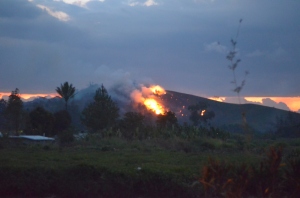
The past couple months have seen very little rain in our area of the highlands, and the situation has begun getting desperate. Fires roam unchecked around us, burning homes and gardens.

This morning I looked out on my usual landscape and saw that “my” mountain had scorch marks and blackened trees, like so many around us. Gardens are now just ashes, as are the homes around them. Some of our Kudjip staff family recently suffered the loss of homes, and even personal savings. They now live in a nearby village trying to piece together their livelihoods.

As our family watched another unchecked fire on the mountains around us last night, Esther said, “It's amazing to just feel so helpless.”


DSC_5800
  Photo: Dr. Ben
 

In two days, my family of five will board a plane bound for the U.S.

In some ways it terrifies me.


When we left nearly two years ago, I honestly didn't know how long we might stay in Papua New Guinea.  When we tore down decorations in our Tulsa rental home, sold our cars, packed a few belongings into crates and said farewell my mind started making excuses.  Excuses to move home sooner - in some ways, almost praying that God would give us an 'about-face' and return us to the States.

Then the work in the hospital started.  And our daughter Lucy was born.  And adventures in the mountains of this rugged country took hold.  And it seemed obvious that we could be here forever.

But patients died.  Children and babies and mothers lost their lives while literally in my handsLevi got sick and I honestly didn't know at the time if he might join their ranks - the longest night of my life.

As reality set in, my heart hardened a bit.  My blogs decreased.  I struggled to diligently catalog the plight and losses encountered by the people of this incredible country.  It seemed like the sorrows of this place started to eclipse the love that brought me here in the first place.


This morning I cried, looking at my scorched mountain, knowing that in a few days I would leave this place to its ongoing struggle. I can't control the rain, and many times, I can't control what ultimately happens to my patients here. Any grandiose thoughts I once had about my own abilities are long gone.

 
I don't know what difference I make in the middle of this. But I feel an overwhelming sense of both sorrow and love at the thought of leaving.

Sorrow because as much as I've invested in this place the past two years, its difficulties remain. The mountain stands scorched. The hospital goes on – every day bringing healing to some, and crying with others. The people continue to piece together their livelihoods amidst challenges – challenges that most of the world doesn't see or consider.

Love because of the beauty of the people around me. My ex-pat colleagues, my Papua New Guinean neighbors and friends, my patients and their families who continue their own journeys in this place. Who every day take the blended steps of joy and heartache along these scorched fields, trusting in the faithfulness of a kinder tomorrow.

But one morning, as I look on my burned mountain, the rain will come again …


“O Lord my God, who dwellest in pure blessed serenity beyond the reach of mortal pain, yet lookest down in unspeakable love and tenderness upon the sorrows of earth, give me grace … “
-John Baillie


Thank you for joining our journey these past two years, and as we look to continue in Papua New Guinea in 2016.

Saturday, July 11, 2015

Burden and wonder

"Turn my eyes to see Your face
As all my fears surrender
Hold my heart within this grace
Where burden turns to wonder
"

Lately I've not been able to get this song out of my head.  I didn't know why, but the words kept creeping into my day.  In the past week or two, I think I've needed it.

I've struggled on several fronts.  

In June we didn't get the vaccines that we needed and I despondantly looked into our empty freezers again this week after asking sister Leah if we'd received any.  Still no, which means hundreds of babies are going without vaccines through no fault of their mothers who are still making the effort to get here.

Two mothers came to see me last week at about 5 months pregnant whose water had already broken.  One of them asked me to give medicine to complete a miscarriage for her, but after seeing the baby's heart-beat, I kept her in the hospital to see if we could protect her long enough to give the baby a chance to live.

This week we delivered three ladies in desperate situations.  Toy's baby has congenitally acquired resistant HIV infection, Lineth's baby has anencephaly and Grace's baby has already succumbed to prematurity.

Kudjip "NICU" and "Ventilator" - a nursing student bag-breathing for Grace's baby

On Monday, Levi began having coughing fits and wheezing.  Dr. Bill graciously came to see him that evening while I was knee-deep in Obstetrical complications at the hospital.  After his scare last year, every cough or sniffle he gets sets me on edge.

One of Esther's patients a few weeks ago told her, "I pray that Lord would just take me, I am so miserable"  For better or worse, I think Oipa's prayers are being answered because he is deteriorating and I can't help him anymore.  But his daughter still takes care of him and I know she dreads what is now inevitable.

Esther's COPD patient, Oipa


At times I feel like the work here is just a string of fears and burdens.  Sometimes, I walk to the hospital every morning as the sun crests above the mountains around me, and with every step I dread walking into the nursery and finding empty cribs.  Or empty beds where I've admitted patients who don't survive.  Or empty freezers where I should have vaccines to protect the vulnerable children of PNG.  And the next step becomes a burden as I'm tempted to go back to my house, my family or my home country where I don't experience the same fears.

Enter grace.

A little boy named Joshua came to Kudjip nearly eight months ago.  His family lived near our hospital, but he fell ill while visiting relatives and was admitted to the nearby government hospital.  After some days, Joshua died and the family brought his body home on a public motor vehicle.  Incredibly, though, while passing our hospital, Joshua began breathing again and was brought into the emergency room, where Dr. Andy Bennett resuscitated him and admitted him to our pediatric ward.

For several weeks, I saw Joshua on weekends, paralyzed and unable to eat or communicate due to what was likely Tuberculous meningitis.  After some time, Joshua wasn't in the hospital when I made weekend rounds.  Bed A7 became another empty bed - confirming in my mind those fears that I carried to the hospital that morning.


"I will fight to follow
I will fight for love
Throw my life forever
To the triumph of the Son
"

My mentor, Bill McCoy, wrote an incredible book collecting the stories of his patients in thirty years of missionary service.  But the story that moves me most is his own.  In it, he relays the familiar tale of a little boy walking along a beach full of stranded starfish.  As the boy tosses them into the ocean, a stranger berates him saying that he can't make a difference given the number of doomed starfish on the beach.  The boy replies as he throws one back, "I made a difference to that one"


About two weeks ago a grandmother brought a child to my room.  It was one of those days full of fear and burden - a day that I just wanted to be home.  I looked in the record book to find what their concern was.  Apparently this boy had one or two isolated seizures in the past few weeks.  I asked the grandmother if the child had seizures in the past.  She said he did last year, for several weeks, after staying in the hospital here for some months.

I flipped a couple pages back.

I turned the book over to see the name on the front.

Joshua sat before me,  smiling in his grandmother's arms.  At first I couldn't believe it.  I turned the book over and over.

"Is this the boy who died at Hagen and came here last year?"

"Yes, that's him"

I asked Joshua to walk to me and he took several unsteady steps across the room before falling into my arms laughing and smiling while his grandmother enjoyed my surprise.


The traditional moral of the story is that I should have an attitude like that little boy - hoping to touch the lives of a few even if I can't make a difference for the many.  But the beach is too full of starfish and I can't keep that up.  I see fears and burdens everywhere, and if I think I'm the one making a difference I will lose heart.
The truth is that I am a starfish - whom God mercifully threw into the life-giving waters.  When I surrender to this idea, my burden becomes wonder.  Wonder that a loving God would count me worth His son.  Wonder that He's given me some abilities to potentially help others away from their own fears and burdens.
 

"Your love has won it all
You took the fall
To embrace my sorrows
I know You took the fight
You came and died but the grave was borrowed
I know You stood again
So I can stand with a life to follow
In the light of Your name
"

Saturday, May 9, 2015

Thick skin


Will your grace run out
if I let you down.
Because all I know
is how to run.
 
Before moving to Papua New Guinea, I started writing blog posts as a way of communicating with those helping us to get here. After more than a year living amongst the highlanders of this island country, seeing their joys and griefs, I realize it's become something different. After a particularly difficult patient, I find that writing their story helps me to absorb who they are, or were – and how to cherish their life while moving forward in my work.

16 months ago we moved here and nearly every patient broke my heart. I came home at the end of call or a typical work day and spent time in prayer, searching for reasons behind the suffering I saw. I admit, after dealing with almost identical stories of abuse, disease, neglect and violence I developed a thick skin. Not every patient touched me. My calluses got thicker and the tenderness that I approached each day with started to wane.


This helps, actually. If I walked to the hospital every day, full of its struggles and loss with bare skin I think I would wear out and return home.

But every once in a while, I think God likes to carve an opening in my thick skin, and in brief moments, He reminds me of the needs of the people here as well as my reliance on Him in trying to help them.

Last week a young woman brought who I thought was her son into my clinic room. Manuel had been having cough and diarrhea for almost two weeks. He looked dehydrated and showed some early signs of malnutrition. I usually wonder, in a young child, if the mother is taking care of them or may have passed on HIV to the baby. I asked, “Is this your baby or did you adopt him?” And she replied “I adopted him last week. My sister, his mother, died two weeks ago in this hospital – you tried to help her but she died and now I take care of him.”


All my thick skin was useless.

As I looked at Manuel and remembered his mother, Ruth, the barbs of reality hit my heart.
I admitted Manuel and he seemed to do well. I went back to his mother's chart, remembering her distinctly but wanting to see if there was something I missed. I looked at her lab slips, an old Xray, her treatments. In it all I saw several things that I might have done differently – but probably not at the time. Of course, in the US things would have been very different, but for the resources we have here, I don't know that her care could have been better. In the physical, medical world I sought answers. But Ruth's story didn't end well, and all the medical answers in the world wouldn't bring me peace as I looked at Manuel, with sunken eyes and a slightly swollen belly.

I knew then and there that I would be writing their story down, but it took nearly a week for me to know how.


You see, I have this idea that I should try and do justice to someone's story or life if I choose to share it with others, particularly on the internet. Part of that represents my wanting to honor their memory, but part of that, I now realize, is selfish. I grew up on stories from the mission field and having followed in those footsteps I feel that I have to tell good stories to others.
As I struggled with Manuel and Ruth's story, I nearly decided to keep it, in fact nearly decided to stop sharing my patients' stories at all.

But this morning as I read, I realized that sharing the lives or stories of my fellow highlanders doesn't have to be long-winded, eloquent or inspiring. Their lives and stories are worth knowing and hearing, and I'm just the one privileged to experience them, even if it hurts at times.

Open your mouth for the speechless,
In the cause of all sons of passing away.
Open your mouth, judge righteously,
And plead the cause of the poor and needy.
-Proverbs 31:8-9

These words resonated with me. And I realized that with all this thick skin, it's been harder to find where Christ is. In the midst of the patients and babies we lose, the stories of abuse and battered women and a culture in great need of transformation, I've lost sight of the reason I came here. I've turned this opportunity into a job. And I learned, through Ruth and Manuel's stories, that every once in a while I need my thick skin to be broken and to feel brokenness. Because in those times, I don't have to look for Christ – He comes to me.

And those moments of comfort send me back to the hospital, praying that I'll be more sensitive and careful with the stories I get to take part in.

"You are a Savior -
You take brokenness aside
and make it beautiful"