Monday, April 14, 2014

Spiritual olympians

I've worked on our pediatric ward for a couple weeks now and will continue there for another few weeks.  The sick children here tug at my heart - some in great ways and others in devastating ones.

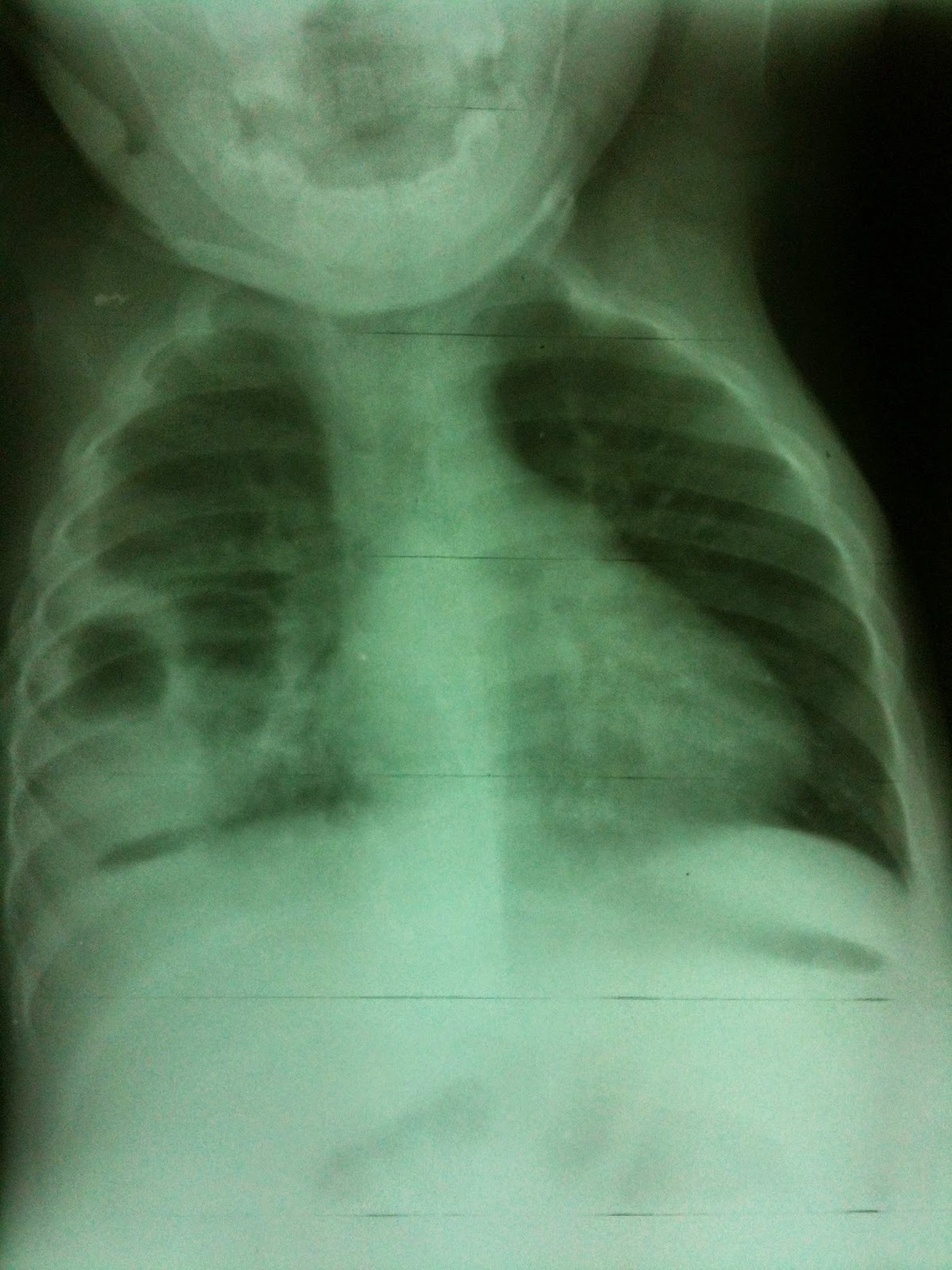
Baby Wendy came to the hospital with cough and fevers looking like she had a bad pneumonia.


After a few days of treatment Wendy's fevers continued.  She wasn't as tired, but still had a bad cough.  Her following Xray looked like this.


A few days earlier I had placed a chest tube in one the babies next to Wendy to drain an empyema (infected fluid around the lung) and thought Wendy might need the same.  But instead, she responded very well to TB medicine and came to see me in clinic looking better with the following Xray.

Although she felt better and her mother felt good about her progress, I couldn't get her to smile for the camera.  Lots of pikininis around here are afraid of the "white-man dokta"


I love stories like Wendy's because in all honesty, three fourths of the patients we see at Kudjip have illnesses that we can treat and sometimes cure.  Many people and families are changed here and several receive care that saves their lives.  A few weeks ago I felt discouraged that three of my nursery babies died but Dr. Jim reminded me that had this hospital not been there for them, ALL of them would have. 


Several years ago Joseph suffered a car accident.  His spine and leg were broken in two places and never healed.  Now paralyzed, Joseph came to me to check up on his blood pressure.  His two sons accompanied him, along with a brother.  I didn't give them any good news. 

Over time, high blood pressure changes the heart.  Because of the increased load, the muscles hypertrophy (get bigger) which overcomes the blood pressure but can make the heart so thick it doesn't function well.  Over time, this causes fluid to build up in the lungs and for the blood not to reach some of the vital organs it needs to, including the kidneys.  Joseph's heart couldn't keep fluid out of his lungs and his kidneys started to shut down which means he doesn't have many more months in this world.

His son on his left takes excellent care of him from what I can gather.  He is built like an olympian, probably because he pushes his father around in his wheelchair along the stony roads of Papua New Guinea and carries him in and out of it.  Over time, like Joseph's heart, his muscles grew to accommodate the increased workload.

Their story makes me think of the individual journeys God gives us to walk.  A friend of ours was recently diagnosed with cancer (actually, we are rather sick of cancer in our friends and loved ones).  I've found that God gives me the strength and grace I need for my circumstances but seldom much more than that.  I wish I could stockpile those some times, especially in Papua New Guinea.  But I think He prefers making me reliant on Him on a daily basis.

Joseph will never walk again barring a miracle.  He now faces a tedious battle against his blood pressure and heart failure issues as well.  But each day I believe his emotional and spiritual reserves will build. 

I think that when we encounter challenges to walk through and endure, perhaps God delights in seeing us come out the other side looking like spiritual olympians.  

Sunday, April 6, 2014

Bel Isi

So I'll be bold as well as strong
And use my head alongside my heart
So take my flesh and fix my eyes
A tethered mind freed from the lies

Sometimes the hardest thing God asks us to do is wait, slow down, stop or stay.  My personal tendency makes me rush to the next patient, the next ward, the next project.  The great need drives me and I know that I have a lot of work to do.  But I look for one person, each day, that I feel I'm supposed to stop, slow down, wait and find out their real needs and hear their words.


My last night on call I was asked to see a patient on our medical ward in the middle of the night.  Metti is an elderly patient with pneumonia.  For some reason, she quickly deteriorated in the night and was extremely short of breath.  As I came into the ward I saw her gasping for air and sweating buckets.   Seeing her in such a state back in America, I would have put a breathing tube in her lungs and kept her on a ventilator until her lungs improved.  But in Kudjip, we don't have that option.

I gave her as much oxygen as I could, inhaled medicines, injection steroids and a shot of magnesium.  I walked to her and she looked terrified as I grabbed both her hands and shared the Gospel with her.  I prayed for her rather than with because she was so short of breath she couldn't even speak.  I went home.

The next morning I went back to her bed and found she was still alive, and breathing a little more comfortably.  She took both my hands in hers and put her forehead to them saying, "Mi tarnem bel" - "I've given my heart" and this time prayed with me through snatches of heavy breathing.

A few days later I went to check on her and found her bed empty.  It turns out that just hours after she clutched my hands in hers her shortness of breath worsened again and she passed into eternal life.


In Tok Pijin someone who is anxious or angry is said to have a "bel hot", bel meaning anything from stomach to heart.  Bel is a sort of catch-all word for describing a person's essence.  When I cry with a new mother as the two of us watch the nurses stop futile resuscitation efforts, I tell them "Yumi one bel" meaning our spirits feel the same.  In my first couple of weeks here I kept hearing people pray for a "bel easy" which I thought was nice, since I pray against worries and anxiety at home.

Some time later I realized that those who are praying are actually asking God to give them "bel isi" which is a little different.  When you want someone to talk more slowly, calm down, slow down, or wait you use the phrase "isi"

It's interesting that in the US where my culture races along at top speeds all the time, we ask God for peace, calmness and rest from anxiety.  At the same time, we hurry into everything around us - meetings, work and church.  In PNG, where the culture already slows a bit, they still recognize that what they really need is a "slow heart" and ask God for this.

In the book of Mark, Jesus heals a man who previously was so out of his mind that he lived in caves and cut and hurt himself.  When the man finds Jesus he is so excited he asks if he can follow him but Jesus actually says no - you can't go, you can't come, I want you to stop and stay and tell others.  "Makem bel isi"


"Go home to your friends, and tell them what great things the Lord has done for you and how He has had compassion on you." - Mark 5:19

This nameless healed follower of Christ stayed home but told others of the great things God did for Him in compassion.

I hope that when God gives me one specific person to help and to change, that I won't be so rushed to miss it.  That I could slow my day on their behalf, and see His compassion do great things for them.

Raise my hands, paint my spirit gold
Bow my head, keep my heart slow

Sunday, March 16, 2014

Lucy Elizabeth

Lucy Elizabeth

On Thursday March 13th, Esther and I welcomed Lucy Elizabeth to our family.  Dr. Bill was worried that Esther's water broke without her going into labor, which could lead to infection for her or the baby.  Until that point, our baby had done very well and was only a few days away from her due date so Uncle Bill gave Esther a medicine to induce her labor.

This experience differed greatly from our past births, in some good ways and some bad ways.  Esther was induced at home and we were able to have dinner and take a walk with the kids through the garden in her early phase.  Bill came to check on her shortly after dinner and though she was only three centimeters dilated, suggested we go to the hospital as he felt "this might go pretty quickly."  Turns out he was right, because less than an hour later, after just ten minutes and a few contractions in the labor room, our little girl was born.

Dr. Bill and Staci Rutledge were superb in helping with the delivery and we were back home in just a few hours.

Dr Bill attends the next generation of Crouch births

It sounds picturesque, doesn't it?  Laboring at home, going to the hospital for a few hours to make sure mom and baby are safe, then coming home to start the process of bringing this little life into our family.  In some ways it is.

But what if it weren't?  I would by lying if I didn't confess a good deal of anxiety leading up to this delivery, and some remaining as we wait for Lucy to feed well and regain weight while she suffers from a little jaundice.

 The reality here remains that most moms and babies do well, no matter what we do for them.  But for those who suffer severe complications, the risks are great.  Newborn asphyxia, respiratory problems, prolonged labor and neonatal infections killed six babies in my first few weeks here.  Separating my little Lucy from any of those fates is God's grace.

  Coming to Kudjip while Esther was pregnant challenged me to trust that God would provide for our safety.  I also came to terms with the idea that I didn't control the outcome for Esther or our baby - and that my obedience in coming here was more important than what that outcome might actually be.

"Surely in whatever place my lord the king shall be, whether in death or life, even there also your servant will be."  -2 Samuel 15:21

Gratefully God blesses us with good things most of the time.  But as His servants, our willingness to follow Him shouldn't really depend on what good things we get.  Our commitment walking in Christ's footsteps should be as servants, whether in life or death.  Even as I write that, my heart skips a beat knowing that as yet, I've not faced a great sacrifice in my family for His service.  

I pray that He would give me strength and that His favor would continue to bring us life and blessings.

Thank you for your thoughts and prayers toward us in this time, and praise God with us that Lucy is here!


Sisters


Happy St. Patrick's day


Tuesday, March 11, 2014

Flawed


Next week will begin a difficult stretch of time at Kudjip.  Dr. Bill McCoy, who has served here nearly twenty years, will be going back to the States on a four-month home assignment.  When I (or nearly anyone else here) gets stumped by a patient we usually go to Bill for advice and direction.  For the next few months we won't get to use this resource.  Beyond that, Esther and I depend on he and his wife Marsha for mentoring in our role as a new missionary family here.

Bill walks me through an X-ray on my first day

Our prayer is that Bill gets to deliver our new baby in the next eight days before he heads back home.  Esther feels that the time is close.  It means big changes in our house, of course, but we appreciate the love and support of our new friends here at Kudjip and the thoughts and prayers of friends and family back home for our newest treasure.

St Patrick's Day baby?

This week I'm covering the Surgery ward for our surgeon Dr. Jim Radcliffe, who enjoys a well-deserved vacation for Spring Break.  I enjoy surgery, but I am certainly not a surgeon.  So far, the patients have done well without complications and Dr. Scot Pringle (visiting Gynecologist) helps with surgical patients and cases in Jim's absence.  My time at Kudjip stretches me professionally to say the least.  The risks, losses and rewards are great.

I wrote previously about a man who suffered several wounds from a suspicious relative.  He continues to recover and I pray for him, his son Tony and their entire family line who have fallen into a tribal conflict.

Koki doing well

There have been more than a few miracles around here lately as well.  Haddie, a young girl who suffered from Pigbel and spent months in the hospital is home!  She began eating on her own and though she is still weak, she's back to the care of her family to return for occasional checkups here.  Most of the doctors and staff here felt that Haddie wouldn't survive, but God had other plans.  Another one of my premature babies is doing well, has gained weight and is almost entirely breast feeding meaning that home is just around the corner.  Pray for Kepis when she takes this little one home to a house where she already looks after four other children.

Kepis and the still unnamed newborn, now 2000g!


I love seeing God's grace on patients here, but of course there are some that don't thrive or even survive.  Dr. Jim counseled me the the other day that we can probably really help about 60-80% of the people we see here.  But the others we must try to show Christ's love even if we have nothing material or medical to offer them.

My last night of call pushed my limits a bit.  It seemed every thirty minutes the phone rang for something.  About one o'clock in the morning I was called to our pediatric "A" ward for a child that was gasping for breath and listless, nearly unconscious.  When I arrived my heart sank.  Two-year-old Resley came to the clinic the day before for recurrent bouts of diarrhea and vomiting for nearly a year, but particularly bad the past two weeks.  I admitted him worried about dehydration and severe malnutrition as he hadn't gained any weight since he was twelve months old.  Resley also suffered from hypoglycemia.  I gave him some sugar, started his fluids and admitted him to the ward.  Now, about twelve hours later, his blood sugar was extremely high.  I changed his fluids, gave him oxygen and prayed with his father, Taman.

In the early morning, about five o'clock, when the sun had just crested the hills and roosters were warming up, I got called back to A ward.  My heart sank as I made my way to the hospital, knowing that this must be Resley.  He had quit breathing and had no pulse.  We resuscitated him to the best of our ability but without success.  Taman wept - he had nine children: eight girls and Resley, his only son.

I still don't know what happened to Resley - I suspect he had a glucose metabolism disorder which might explain his failure to thrive since weaning from breast-milk and poor ability to tolerate solid foods.

That day I went back through Resley's illness, trying to figure out if there might have been something I missed or managed incorrectly.  He was certainly ill, but I took it hard that he didn't last the night.  Then a mother brought me her thirteen-month-old daughter who was malnourished and dehydrated and I admitted her to hospital.  I struggled with the paperwork, going through my orders with a fine-toothed-comb and had Bill double check me.  He could tell I was accepting too much blame for Resley's death and told me as much.

Perhaps I made a mistake.  Perhaps there was something I missed.  Or perhaps, in God's providence, Resley's life and death will make an impact that I'll never understand or appreciate.  I see now that while our efforts here are mixed with God's grace, there are things that we still cannot do or cannot do well.  Whatever happened to Resley, his life and death taught me to accept that though redeemed, I am still flawed.  In spite of my flaws, God can make my efforts fruitful for those that he brings under my care.  Even if it is only 60-80% of the time.

Do I dare to dream
of a Kingdom where I'm not King.
Of a richness without dollars
and my life belongs to others
and I would gladly be the least of these.

-Brooke Williams


Sunday, March 2, 2014

Walk Away

 
Some moments I want to go back to the States where I can drive a car whenever I want, take Esther on a date and escape to a cafe or watch football with my brothers.  I want to take Anna and Levi to the Oklahoma Aquarium and then to Chik-Fil-A before a walk through Turkey Mountain ("Urban Wilderness").  I want to give my patients the best un-expired medicines available, use the most important diagnostic tests for them and get the opinion of a specialist on their illnesses.  In essence, I want to walk away.  Away from an unending stream of poor, broken and needy people and the job of tending to them with my limited skills and a small variety of testing, technology and medicines.
 
Deborah delivered her baby at home in a remote area because she couldn't get access to an aid post, health center or hospital.  In the first couple of days her baby girl couldn't breast-feed.  Most likely that is because Deborah was only about seven months pregnant when she delivered her.  Her baby weighed just one and a half kilos or so (3 pounds, 5 ounces).

Deborah put her baby in a bilum (bag), strapped it over her head and hiked over the mountains to catch a public motor vehicle up the Highlands Highway to Kudjip.  Thankfully, a doctor named Bill McCoy decided thirty years ago that he would spend his medical career tending the poor, broken and needy people overseas.  Bill promptly gave the infant intravenous fluids carefully calculated out for its small size and treated it with antibiotics for neonatal sepsis.  About twelve hours later, Deborah and her baby came under my medical stewardship.
 
Fast-forward two weeks.  Deborah's baby lost weight, down to 1.19 kg (2 pounds 10 ounces).  However, she rebounded, finished her antibiotics, started eating and miraculously hasn't experienced any breathing trouble.  In fact, Deborah has started breast-feeding her and she has gained nearly 10 ounces. 


What will happen next?  Around here is anyone's guess.  But I pray every morning for Deborah, Kepis, Amanda and Moreen whose tiny babies have been under my care, some for an entire month.  Their mothers echo my "Amen" as I leave the nursery and head to the wards, the ER and our outpatient department to face more of the needy peoples of Papua New Guinea.

Twelve years ago I went to Newcastle, England to begin a training program that would change my life.  During my time working with MercyShips I felt that God called me to medical missions.  In the last twelve years I haven't given up on that, but now that I'm here I need even more of that same perseverance.
 
I love that my faith follows in a rich legacy of endurance, particularly in its call to take care of those who have been forgotten.  Solomon, the wisest ruler the world has ever known, recognized that God made a point of acting on their behalf.
 
My last night on call I treated several men who were involved in a tribal fight.  I stitched a couple of them but one suffered a wound in his arm that put a small tear in the tissue surrounding his brachial artery.  Another millimeter deeper and this wound would have cost this man, Jack, his arm and probably his life.  Our surgeon Dr. Jim graciously came late at night to assist me in stabilizing his injury.  I didn't sleep much that night and missed what might have been a family night at home. 


"For He will deliver the needy when he cries, the poor also, and him who has no helper.  He will spare the poor and needy, and will save the souls of the needy.  He will redeem their life from oppression and violence; and precious shall be their blood in His sight."
Psalm 72:12-14
 
The precious blood of the needy sounds so poetic when I sit in a comfortable chair reading about it with a cup of coffee.  But when I get called to the emergency room at midnight and see the floor literally covered with the blood of our latest bush-knife victim, poetry is the last thing on my mind.  In that moment, the things I need most are strength and perseverance from the One who will spare them, save their souls and redeem their lives. 
 
 
I don't wanna be someone who walks away so easily
I'm here to stay and make the difference that I can make
...
I had to learn what I've got, and what I'm not, and who I am.

Thursday, February 20, 2014

Wanem bai kamap bihain

"What will happen next?"

Today I visited with a patient in our clinic for some time. 

On the 5th of February, a relative thought that Koki was being unfaithful to his wife.  His sister-in-law became enraged and attacked Koki with a bush-knife.  He suffered several knife wounds, losing part of his hand and breaking bones in his foot.

The bush-knife pervades society here, and even children as young as four or five will carry small ones.  The nurses in the emergency room  created the acronym "BKW" which means Bush-knife Wound, because they see them so commonly.

Unfortunately the other thing that pervades society here is revenge.  Any attack potentially begins a tribal or "line" war.  In Koki's case, his son, Tony took matters into his own hand and killed the woman who attacked Koki.  Now Tony occupies a cell in the nearest prison awaiting Kot, or trial.


Around here, what comes next is anybody's guess.  Tony might pay some compensation.  He might have to live in prison.  He might be released and later fall victim to yet another revenge killing.

The past two weeks have seen healing come to Koki's body, but I spent most of my time speaking into his heart.  

When I asked Koki what will come from all of this he wasn't sure either.  Koki has attended church, and most people from PNG love Bible stories.  I went through the story of David and Saul - that David would not take matters into his own hand against Saul when he had him at his mercy, even though Saul had tried to kill David and hunted him in the wilderness.  Koki nodded and seemed to understand.  I asked him what he thought the story meant.  He said that it was not our place to take Kot into our own hands but leave it to God.

"Let the Lord judge between you and me, and let the Lord avenge me on you.  But my hand shall not be against you." - I Samuel 24:12

What if Koki had understood and learned this lesson years ago?  What if he taught Tony that lesson when he was younger?  Would Tony be a free man?  Would a now murdered lady still breathe and walk among us here at Kudjip?  I don't know what could be - and I don't believe God intends that we should ever know what might be different in our lives if circumstances changed.  

But I believe He has placed me here for a reason.  The more I see the victims of revenge and violence here, the more compelled I am to urge them to Peace.  The more my heart breaks for my patients.  The more I fear for those I may see in a week or a month from the same tribal fight.  The more I wonder aloud in my prayers, "What will happen next?"


Monday, February 10, 2014

Nameless

Rachel, Jennifer, Jeremiah

 Meet Rachel, her daughter Jennifer and her son Jeremiah.  Rachel brought up five children, and Jeremiah is the youngest.  All of her children live close to her, which is good because Rachel is dying.
A few months ago, Rachel was admitted to the hospital with congestive heart failure.  Her heart doesn't pump blood properly, probably from years of untreated hypertension.  Because of this, she gets short of breath anytime she walks.  Now her kidneys are shutting down.  When she left the hospital, her creatinine level was 7 and now it is 11, for those medical folks out there.
I told Rachel this week that she was dying when she came to see me in clinic.  Jennifer cried.  Rachel said that she felt something was very wrong but didn't know how serious it might be.  She trusts God and believes in Jesus as his Son.  I cried and prayed with this family - my first prayer in Tok Pijin.  Then I saw the next of dozens of clinic patients, many who are like Rachel.

Dr. Bill McCoy wrote a book called Until We All Have Names some years ago describing the plight of some of his more memorable patients working in Swaziland and here at Kudjip.  In it, he points out that the broken and suffering peoples of the world are often nameless, which I touched on in my last blog.  But God knows each of their stories.  Though Rachel's story will end sooner than most, He has allowed me to see into the lives of her and her family.  And there are many more.  For the privilege of putting names to those lives, I am grateful.


Anna at the orphanage outreach church

Last weekend Anna and I attended Lotu (church) at a nearby Orphanage.  Dr. Jim (Kudjip's surgeon) preached a very good sermon in Pijin and played the trumpet while his wife acted out the Hannah and Samuel bible story.  Did I mention their children Josiah and Lydia played the guitar for worship?  I will be having a serious discussion with God about the distribution of talent when I get to Heaven.  Anna and I enjoyed the service, which took place in a grass-hut church in the mountains just off the Highlands Highway.  

After this, we came back to Kudjip for English Lotu, a once-a-month all-English church service put on by the staff here and attended by many of the expat missionaries in the surrounding areas.  It helps that a potluck lunch precedes the service, which our family gladly took part in.

After Levi's attempt to perform salad-tong Cesaran on Esther, we restricted him to the wooden variety

 Some things I love, and one of them is when a child I really worried about improves and gets read to go home.  I wrote about Steward, a 13-month old boy who spent much of his life sick.  He came to Kudjip about ten days ago deathly ill with fever and what looked like meningitis to me.  Turns out Steward had a bad pneumonia and likely has pulmonary hypertension, explaining his recurrent bouts of respiratory issues since his birth.  Dr. Susan Myers at Kudjip trained as a Pediatrician and has good skills with ultrasound in children as well.  She identified Steward's condition and started him on medicine for his heart and he has finished his antibiotics.  Now he eats, drinks, pees and poops normally and may be able to wean off oxygen and go home in the next few days.

Steward looking bags better, now hoping to wean from oxygen

I also love healthy moms and healthy babies.  Magdalene delivered her baby on the 6th.  She experienced a retained placenta which needed manual removal resulting in a large tear.  But her baby boy thrives and she feels well enough to go home.  She gave me a bilum (bag) as a gift for delivering her baby.  During the delivery process she prayed for strength from Jesus for herself and even for me.  I feel blessed to have been there for her and her baby and will proudly wear my bilum to and from the hospital now!


Please pray for my confidence and trust.  I love seeing the moms and babies that we can help here, but my heart breaks for each of the babies we lose due to prematurity, congenital defects or neonatal infections.  I also struggle with wanting to control many of the small things in my patients.  But I know that ultimately my obedience to God and service to Him and to them makes a greater impact than my medical knowledge in this place.

Thank you for joining us in this adventure with your prayers, your thoughts and your generous giving.